
This MAP calculator (Mean Arterial Pressure calculator) finds the average arterial blood pressure during a single cardiac cycle. Its value is derived from a patient’s systolic and diastolic blood pressures. In this article, we provide you with a definition of MAP, the normal mean arterial pressure level, teach you how to calculate the mean arterial pressure, and present you a handy MAP equation that you can use for manual calculations, including pulse pressure calculation.
MAP Calculator
Mean Arterial Pressure - Advanced Medical Assessment Tool
Results
| MAP Category | 24-hour MAP | Risk Level |
|---|---|---|
| Low | < 60 mmHg | Inadequate perfusion |
| Normal | 60-89 mmHg | Low risk |
| Elevated | 90-92 mmHg | Moderate risk |
| Stage 1 Hypertension | 93-96 mmHg | Increased risk |
| Stage 2 Hypertension | > 96 mmHg | High risk |
Calculation History
About MAP Calculation
Mean Arterial Pressure (MAP) is a measure of the average blood pressure in a person's arteries during one cardiac cycle. It's considered a better indicator of perfusion to vital organs than systolic blood pressure alone.
This formula accounts for the fact that the diastolic phase lasts twice as long as the systolic phase in a normal cardiac cycle.
Clinical Significance
MAP is crucial for determining if there's enough blood flow to supply oxygen to vital organs. A MAP of at least 60 mmHg is necessary to maintain adequate perfusion of vital organs.
MAP Calculation Report
Table of Contents
Maintain optimal cardiovascular health with our free MAP calculator and Mean Arterial Pressure calculator – essential medical tools for accurate blood pressure assessment. This advanced health calculator allows you to easily calculate MAP using the standard mean arterial pressure formula to determine if your readings fall within the normal map range. Perfect for medical professionals, nurses, and medical students, our online medical tool provides instant systolic diastolic pressure analysis and comprehensive hypertension management support. As a reliable clinical tool and vital signs calculator, it serves as a crucial resource for patient education, preventive healthcare, and DIY health assessment, helping users monitor their arterial pressure and overall heart health through precise blood pressure monitoring and healthcare technology
The systolic and diastolic blood pressures of a patient give it its value. In this post, we’ll explain what MAP is, what the typical mean arterial pressure level is, how to find the mean arterial pressure, and provide you a useful MAP equation that you can use to do calculations by hand, such as finding the pulse pressure.
You will also learn how to check your blood pressure and what the hazards are of having high blood pressure.
What is mean arterial pressure?
The mean arterial pressure (MAP) is an estimation of the time-weighted average of blood pressure in large system arteries throughout the cardiac cycle. It has a direct link to the amount of blood the heart pumps.
You need two numbers to figure out the MAP: your systolic and diastolic blood pressure. They are commonly expressed in the form XX/YY, where XX is the systolic pressure, and YY is the diastolic. For instance, a person with a blood pressure of 120/80 has an SBP of 120 mmHg and a DBP of 80 mmHg. In the next paragraph, we will tell you how to measure blood pressure.
What exactly are systole and diastole? To put it simply, systole is the contraction phase of the human heart, when blood is pumped from the heart to circulation. During the diastole phase, sometimes called the relaxation phase, the ventricles are filled with blood. Blood pressure is substantially higher during the systole than during the diastole.
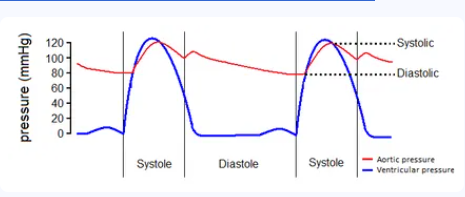
Take a look at the illustration above. The diastole phase corresponds to two-thirds of the cardiac cycle, while the systole phase occupies only one-third. This is why MAP is not calculated as an arithmetic average, but rather as a weighted average.
How to measure blood pressure?
There are a few ways to measure blood pressure. In this paragraph, we will present just non-invasive techniques of measuring blood pressure.
The fastest approach to assess blood pressure is via palpation – finding a pulse over patient’s arteries. Although not particularly accurate, it is extremely beneficial in emergencies: saving victims of vehicle accidents, patients enduring cardiac arrest, etc. It is thought that when the systolic blood pressure of a patient is over 70 mmHg, the pulse should be felt over carotid (on the neck), femoral (in the groin area) and radial (around the wrist) arteries. When the systolic blood pressure drops to > 50 mmHg, we can feel the pulse exclusively over carotid and femoral arteries and with a pulse between 40–50 mmHg, just over carotid artery.
The most popular technique of monitoring a patient’s pulse by a doctor in a hospital setting, is by utilizing a stethoscope and sphygmomanometer. The doctor inserts a cuff of the sphygmomanometer over the patient’s arm and sets the stethoscope over the brachial artery at elbow level. He inflates the cuff and then starts slowly releasing the air carefully noting the value of pressure inside the cuff shown by the sphygmomanometer. When he begins to hear a characteristic whooshing-like sound, he records down the currently reported pressure — this is the systolic blood pressure of the patient. The doctor continues to deflate the cuff until he stops to hear the thumping. At this moment sphygmomanometer indicates the diastolic blood pressure of the patient. The healthcare specialist is now ready to determine the mean arterial pressure!
There is a medical problem called as “white coat syndrome” (or white coat hypertension). Many people fears being examined by a doctor and, during measurement, their blood pressure elevates as a response to the stress they are feeling. This gives falsely elevated findings of blood pressure test and can lead to unneeded therapy. Below the last approach of how to measure blood pressure eliminates this difficulty.
We are talking about oscillometry. You may have encountered when you visited your grandma. She put a cuff from an odd looking device around her arm, pushed some buttons and then waited immobile for a moment while the device hummed. The device was a blood pressure monitor. In this procedure, blood pressure is determined by detecting and analyzing the oscillation of the blood flow (the pulse) inside the brachial artery. The complete operation is performed automatically. All you need to do is to remember to calibrate the device once in a while so it’s functioning effectively and able to obtain the correct results.
Normal blood pressure,
The normal blood pressure for a healthy adult should measure between 90 mmHg and 119 mmHg for systolic blood pressure and between 60 mmHg and 79 for diastolic blood pressure.
We identify prehypertension when a patient has a systolic blood pressure between 120 mmHg and 139 mmHg. Lower than normal blood pressure is called hypotension, and greater than normal blood pressure is hypertension.
We shall discuss about the risks of hypertension in the last paragraph of this essay.
MAP equation — how to calculate mean arterial pressure?
You can use the following mean arterial pressure formula:
MAP = 1/3 × SBP + 2/3 × DBP
where
MAPis the mean arterial pressure,SBPis the systolic blood pressure, andDBPis the diastolic blood pressure.
That’s it! Now you know how to calculate mean arterial pressure!
The calculation accounts for the duration of the diastolic portion of the cardiac cycle — note the component preceding the SBP and DBP. At a normal resting heart rate , the systolic phase is twice as short – that means that the ventricles need twice as much time to fill with blood than to pump it out.
This association can be different in patients with bradycardia or tachycardia. Such patients cardiac cycle is slightly changed (the shape of the arterial pressure pulse becomes “narrower”), and the MAP is closer to the arithmetic mean of SBP and DBP. In these circumstances electronic circuitry or digital approaches are often required to find the MAP.
Normal mean arterial pressure,
It is generally believed that MAP levels should not fall below 60 mmHg to maintain adequate tissue perfusion. Patients with severe sepsis or septic shock should have their MAP levels kept at about 65 mmHg at all times.
The normal mean arterial pressure in healthy patients should be between 70 and 100 mmHg. The values should never exceed 160; such a result reflects excess cerebral blood flow and may result in raised intracranial pressures.
What is pulse pressure? — pulse pressure calculation
Pulse pressure is the difference between systolic blood pressure and diastolic blood pressure. The pulse pressure correlates to the volume of blood evacuated during a contraction of the left ventricle of the heart to the aorta and other arteries. We call this amount of blood the stroke volume. The bigger the stroke volume is, the higher the value the pulse pressure reaches. Stroke volume increases for a number of reason, but the most common is activity. The compliance of the aorta is, in turn, a characteristic that has a detrimental impact on pulse pressure. We define compliance as the ability to stretch in response to the pressure inside a vessel-like organ of our body. Let’s offer an example. Suppose that you are trying to inflate a balloon for your friend’s birthday party. A balloon with high compliance would be easier to inflate (you wouldn’t have to blow into it with as much power), than a balloon with low compliance.
Physiologically, the aorta is rather elastic, meaning it has great compliance. Because of that, our pulse pressure maintains at a healthy range of around 40 mmHg. In some circumstances, such atherosclerosis (narrowing and hardening of blood vessels due to formation of plaque) or aortic dissection (a state in which blood gets between layers of aortic wall), the aorta may become stiff. This increases the value of pulse pressure
ther pathologies associated with an increased pulse pressure include:
- Fever.
- Aortic regurgitation — a leak in the aortic valve, causing an inversion of blood flow in the aorta during diastole.
- Anemia — a low level of hemoglobin (an oxygen-transporting protein present in the red cells).
- Pregnancy.
- Increased intracranial pressure — with symptoms of Cushing’s triad: high blood pressure, slow heartbeat (bradycardia), and irregular breathing.
- Endocarditis — an inflammation of the inner layer of the heart wall.
- Hyperthyroidism — excessive production of the thyroid hormone by the thyroid gland.
You can use the mean arterial pressure calculator to perform the pulse pressure calculation PP. Simply subtract the diastolic pressure from the systolic one:
PP = SBP - DBP
How to calculate MAP and PP using the mean arterial pressure formula
Let’s calculate the MAP of a person with a blood pressure of 120/80.
- Determine the SBP (systolic blood pressure). It is the first number — in this case, 120 mmHg.
- Find the DBP (Diastolic blood pressure). It is the second number — here equal to 80 mmHg.
- Input these numbers to the MAP equation:
MAP = 120 × 1/3 + 80 × 2/3MAP = 40 + 53.33MAP = 93.33 mmHg- You can also perform the pulse pressure calculation by subtracting the DBP from the SBP:
PP = SBP - DBP = 120 - 80 = 40 mmHg
When should you monitor MAP?
Mean arterial pressure is regarded to be a better indication of tissue perfusion than SBP exactly because it accounts for the difference between the duration of the diastole and systole sections of the cardiac cycle. Hence, it is often monitored in cases of organ perfusion problems. Some of these cases include:
- Septic shock — a state of insufficiently low blood pressure caused by a substantial inflammatory response due to an infection. Damaged organs, our immune response, and cytokines (signal molecules) all cause blood vessels to dilate (broadening), resulting in low blood pressure.
- Cardiac patients on vasodilator infusion, for example, nitroglycerine (GTN — glyceryl trinitrate) — one of the most used medicines for the treatment of angina (pain in the chest caused by a too-low oxygen supply for the heart), heart failure, and high blood pressure. Nitroglycerine is reduced in our body to a form of nitric oxide (NO), which is a strong vasodilator. Although helpful in many situations, glyceryl trinitrate has some side effects. It causes headaches and hypotension — too low blood pressure. To avoid the occurrence of such unpleasant or dangerous events, nitroglycerine and every other drug has to be dosed very carefully.
- Head injuries — damage to a specific region of a human brain — rostral ventrolateral medulla (RVLM), located in the brain stem, may cause pathologies of blood pressure. RVLM, through neural fibers of the autonomic nervous system, controls the speed of the heart rate, the force of its contraction and the level of contraction or dilation of arteries and veins. Even an increased intracranial pressure may manifest as the already mentioned Cushing’s triad: slow heartbeat, high mean arterial pressure and irregular breathing pattern. You can determine your patient’s heart rate by merely looking at the results of his ECG test. Check our ECG heart rate calculator to find a tool that will do all the math for you! You will also learn some tips and tricks to quickly evaluate someones heartbeat all by yourself.
- Dissecting abdominal aneurysm — a surgery procedure in which a doctor cuts out a weaker segment of the abdominal aorta, thus preventing it from bursting. This can save the patient from bleeding to death!
Comparing two blood pressure scenarios with the MAP calculator
Let’s assume you have two patients, one with the blood pressure measurement 110/40 and the second with a pressure 90/65. Which blood pressure is better?
Intuitively, we concentrate on the first number — the systolic blood pressure. If it was the only indicator, we would say that the first patient has a better blood pressure. But what happens if we calculate MAP?
MAP1 = 110/3 + 40 × 2/3 = 63.33 mmHg
MAP2 = 90/3 + 65 × 2/3 = 73.33 mmHg
The mean arterial pressure of the first patient is much lower and hence worse. This example shows that diastolic pressure plays a vital role in determining the health condition of the patient.
Hypertension — high blood pressure
Although we monitor the mean arterial pressure mainly for fear of it dropping too much, the majority of people should worry instead about having a too high blood pressure — hypertension.
As we have already mentioned, blood pressure is considered high when the systolic blood pressure is equal to or above 140 mmHg and/or the diastolic blood pressure is equal to or above 90 mmHg.
Chronic hypertension leads to:
- Heart attack.
- Heart failure — when the heart is no longer able to pump blood against such high pressure in the arteries.
- Vessel damage — high blood pressure may create aneurysms, an outward balloon-like bulging in walls of arteries. This can lead to a bursting of artery and internal bleeding.
- Stroke.
- Kidney failure.
- Blindness.
- Cognitive impairment.
FAQs
Why is mean arterial blood pressure important?
Many physicians consider mean arterial pressure to be a better measure of the effectiveness of blood reaching the organs than systolic blood pressure. This makes it quite helpful in diagnosis, as it can quickly rule out many pathologies.
Does high blood pressure mean you have clogged arteries?
Not necessarily, as there are many causes of increased blood pressure, but clogged arteries cannot be ruled out. If you are experiencing a constant high blood pressure, please consult a doctor as soon as possible.
What is mean arterial pressure used for?
Mean arterial pressure is used to assess the average pressure in someone’s arteries over one cardiac cycle and is a measure of how much blood is reaching the major organs. It is used extensively when treating patients with head injury, stroke, or sepsis.
How do you increase mean arterial pressure?
The two most common ways of increasing mean arterial pressure are to increase the total volume of blood, or to administer a drug that tightens the blood vessels, such as norepinephrine.
How do I lower mean arterial pressure?
Mean arterial pressure is usually lowered by increasing the radius of the blood vessels, usually with a drug. There are several different types of drugs, each working in a different way. If you have sustained high mean arterial pressure, please consult a doctor.
What happens to mean arterial pressure during exercise?
Mean arterial pressure increases slightly during exercise. While total cardiac output increases, raising pressure, the total resistance of the system decreases, reducing it. The result of these to cancelling effects is only a slight increase.
Are arterial blood pressure and mean arterial pressure different?
Yes, arterial blood pressure and mean arterial pressure are different. While arterial blood pressure can be either systolic or diastolic, referring to the phases of a heartbeat, the mean arterial pressure is the weighted average of these two measurements over a single beat.
Can mean arterial pressure equal ICP?
Mean arterial pressure can equal IntraCranial Pressure (ICP), but this is a life-threatening condition. This would mean that blood can no longer pass into the brain, starving the brain of blood and potentially killing the patient.
How do I calculate mean pulmonary artery pressure?
- Measure the diastolic pulmonary artery pressure and systolic pulmonary artery pressure.
- Divide the systolic pulmonary artery pressure by 3.
- Multiply the diastolic pulmonary artery pressure by 2/3.
- Add the two results together, this is the mean pulmonary artery pressure.
Why is mean arterial pressure divided by 3?
Mean arterial pressure is not divided by 3, but the systolic and diastolic artery pressure are (although the diastolic is doubled first). This is because we want to average the pressure over both phases, and the diastolic phase is twice as long as the systolic phase.